
History of Tea in America
The Revolution Began in a Teacup
Follow the Tea from China's Forbidden Mountains to Boston Harbor



TEA TIMELINE · 1647 TO 1773
When Did Tea Come to America?
Six Tea Moments That Led to the American Revolution
Tea came to America in 1647, carried by the Dutch to New Amsterdam. It became a colonial passion, a British tax, and on December 16, 1773, the spark of a revolution.

1647: Tea Reaches New Amsterdam
Who brought tea to America? The Dutch. When Peter Stuyvesant became governor of New Amsterdam, now lower Manhattan, he brought tea with him. “The very first tea in America happened in 1647, even before they had tea in London,” says tea historian Bruce Richardson in the film.

Early 1700s: The Colonies Fall in Love with Tea
“Socially, Americans were crazy about tea,” says Evan O’Brien of the Boston Tea Party Ships & Museum in the film. Over one million pots of tea were boiled in the American colonies. Chinese porcelain and tea sets became the mark of a fine home.

1764: Tea Becomes Britain's Third-Most Valuable Import
By 1764, tea was the third-most valuable import for the British, and Britain looked to its colonies for tax money. As Bruce Richardson tells it in the film, King George III said to tax the ladies of Boston whatever you want: they will never give up their tea.

1770: Every Duty Falls but the Tea Tax
After colonial protests, the British Parliament abolished all import duties in 1770, except the most important one: the tax on tea. Many Americans smuggled Dutch tea rather than pay for taxed East India Company tea.

May 10, 1773: The Tea Act
On May 10, 1773, the Tea Act granted the East India Company a monopoly on tea sales in the colonies. For Americans already angry at taxation without representation, it was the final insult.

December 16, 1773: The Boston Tea Party
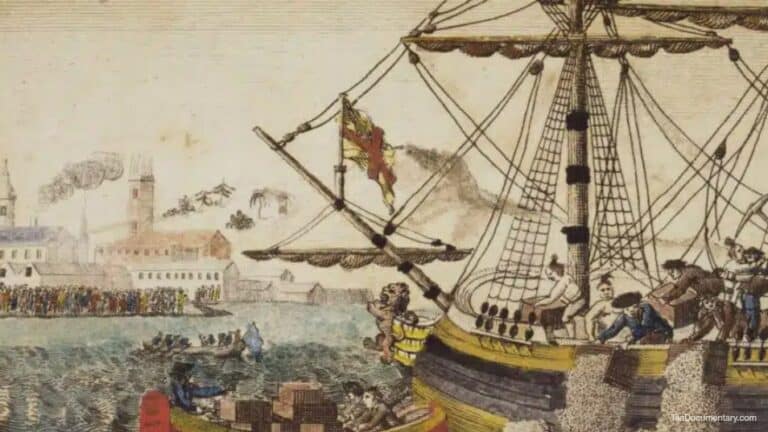
At the Old South Meeting House, Bostonians debated the tea aboard three ships in the harbor. That night, 340 chests of East India Company tea went into Boston Harbor. Every chest came from China. Two-thirds came from the Wuyi Mountains (武夷山).
Witness the history of tea in America in the documentary, TEA: The Drink That Changed The World. Watch free at teadocumentary.com/watch, or stream ad-free on Amazon.
HISTORY OF TEA IN AMERICA
8 Key Tea Moments: How America Embraced Tea
After the Revolution, Americans did not give up tea. They grew it, iced it and bagged it. These are the moments that made tea American.
| Year | Key Tea Moment | Where |
|---|---|---|
| 1799 | The first tea bushes reach the United States, in a plant shipment for French botanist André Michaux | Middleton Place, near Charleston, South Carolina |
| 1848 | Junius Smith starts the first commercial tea crop in America | Golden Grove Plantation, South Carolina |
| 1879 | The oldest known sweet tea (iced tea) recipe in print appears in Housekeeping in Old Virginia | Virginia |
| 1888 | Dr. Charles Shepard founds the 100-acre Pinehurst Tea Plantation | Summerville, South Carolina |
| 1904 | Iced tea is popularized at the World's Fair (not invented there) | St. Louis, Missouri |
| 1920s | Tea bags go into commercial production, after New York merchant Thomas Sullivan mailed tea samples in silk bags around 1908 | United States |
| 1987 | Mack Fleming and Bill Hall buy Lipton's tea research farm and grow American tea | Wadmalaw Island, South Carolina |
| 1995 | South Carolina names South Carolina-grown tea its official hospitality beverage | South Carolina |
Sources: Smithsonian Magazine · Georgia Public Broadcasting · TeaTime · UK Tea & Infusions Association · Wikipedia: Charleston Tea Garden · South Carolina Statehouse, Act No. 31 (1995)
"The sweetest thing you could put into tea is gossip."
— Bruce Richardson, tea historian, in TEA: The Drink That Changed The World
FROM THE BIRTHPLACE OF BLACK TEA
The Tea That Sparked a Revolution
Lapsang Souchong ignited the American War of Independence.
— Mr. Jiang, Chairman of the Lapsang Souchong Tea Company · 24th-generation Black tea master, Wuyi Mountains, China · in TEA: The Drink That Changed The World
By his family’s record, 234 of the 340 chests thrown into Boston Harbor were Bohea Wuyi tea, the Lapsang Souchong (正山小种) his ancestors first made in the mid-1500s.
FROM THE FILM
History of Tea in America, on Film
The film was shot at the Old South Meeting House and the Boston Tea Party Ships & Museum, and in China’s forbidden Wuyi Mountains, where most of the Boston Tea Party’s tea was grown.
Watch: Official Trailer
Filmed Where It Happened
Every chest of tea thrown into Boston Harbor came from China. The film follows that tea from the Wuyi Mountains, where Mr. Jiang’s family has made it for 24 generations, to Boston’s Old South Meeting House, where colonists gathered on December 16, 1773.
TEA HISTORIAN BRUCE RICHARDSON
The Straw That Broke the Camel's Back
It pretty much was the straw that broke the camel's back.
— Bruce Richardson, tea historian, Boston Tea Party Ships & Museum · author of A Social History of Tea · on the Tea Act of 1773, in TEA: The Drink That Changed The World
HISTORY OF TEA IN AMERICA
History of Tea in America in Pictures
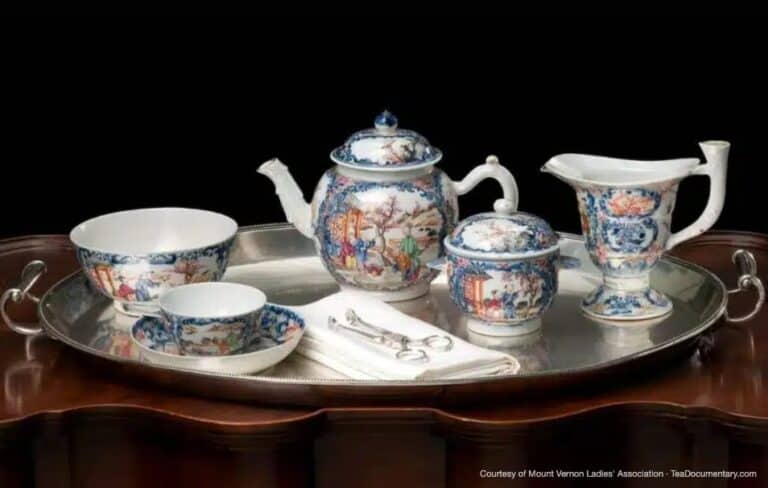
"So our very first President, George Washington, sent off a request to China to have a set of tea things made for him." — Bruce Richardson
From George Washington’s tea table to the night of the Boston Tea Party, these images trace the history of tea in America.

History of Tea in America Frequently Asked Questions
The history of tea in America, answered: who brought it, what tea went into Boston Harbor, where it came from, and what survives.
What is the history of tea in America?
The history of tea in America runs from Dutch New Amsterdam in 1647 to the Boston Tea Party in 1773, and on to iced tea and American-grown tea.
The Dutch brought it to what is now New York. Britain taxed it, and in 1773 colonists dumped 340 chests of Chinese tea into Boston Harbor, a spark of the American Revolution.
Discover the history of tea in America in the documentary, TEA: The Drink That Changed The World. Watch free at teadocumentary.com/watch, or stream ad-free on Amazon.
When did tea first arrive in America?
Tea first arrived in America in 1647, when the Dutch brought it to New Amsterdam, now New York.
Peter Stuyvesant, the colony's new governor, came with tea. "The very first tea in America happened in 1647, even before they had tea in London," tea historian Bruce Richardson says in the film, a full eleven years before London's first tea advertisement.
Explore the history of tea in America and tea's journey from China to the New World in the documentary, TEA: The Drink That Changed The World. Watch free at teadocumentary.com/watch, or stream ad-free on Amazon.
What tea was dumped at the Boston Tea Party?
Five Chinese teas were dumped at the Boston Tea Party: the black teas Bohea, Congou and Souchong, and the green teas Singlo and Hyson.
340 chests went into Boston Harbor. By the family record of Mr. Jiang, a 24th-generation Black tea master in the Wuyi Mountains (武夷山), 234 were Bohea Wuyi tea, the Lapsang Souchong (正山小种) his ancestors made.
Uncover the tea behind the Boston Tea Party in the documentary, TEA: The Drink That Changed The World. Watch free at teadocumentary.com/watch, or stream ad-free on Amazon.
Where did the Boston Tea Party tea come from?
The Boston Tea Party tea came from China. Every chest did, and two-thirds came from the Wuyi Mountains (武夷山).
It was not from India or Ceylon. In 1773, China was the only country that made tea for world trade. India would not produce tea commercially until the mid-1800s, after Britain smuggled China's tea secrets out of the Wuyi Mountains.
Unearth the history of tea in America and its roots in China in the documentary, TEA: The Drink That Changed The World. Watch free at teadocumentary.com/watch, or stream ad-free on Amazon.
Why did the colonists protest the Tea Act?
The colonists protested the Tea Act because it gave the British East India Company a monopoly on their tea while the tea tax stayed in place.
In 1770 Parliament dropped every import duty except the one on tea. On May 10, 1773, the Tea Act followed. Seven months later came the Boston Tea Party.
Step into the night that changed the history of tea in America in the documentary, TEA: The Drink That Changed The World. Watch free at teadocumentary.com/watch, or stream ad-free on Amazon.
Which American presidents drank tea?
George Washington and Thomas Jefferson both drank tea, and both bought Hyson, a Chinese green tea.
Washington took three cups of tea without cream at breakfast and sent to China for his tea things. Jefferson wrote that he preferred "young hyson" and bought about 20 pounds of tea a year for Monticello.
Experience tea at the tables of America's first presidents in the documentary, TEA: The Drink That Changed The World. Watch free at teadocumentary.com/watch, or stream ad-free on Amazon.
How much was the Boston Tea Party tea worth?
The Boston Tea Party tea was worth about £10,000 sterling in 1773, about $1.5 million today.
Evan O'Brien, Creative Director of the Boston Tea Party Ships & Museum, says in the film that it was "a very, very expensive loss" to the East India Company, and "quite the shock to the English Treasury as well."
Witness the cost of the Boston Tea Party in the documentary, TEA: The Drink That Changed The World. Watch free at teadocumentary.com/watch, or stream ad-free on Amazon.
What survives from the Boston Tea Party today?
The Robinson's Tea Chest, made in Canton, China, is the last surviving artifact of the Boston Tea Party.
The Old South Meeting House also still stands in Boston, where colonists gathered on December 16, 1773, before the tea went into the harbor. The documentary filmed at both the meeting house and the Boston Tea Party Ships & Museum.
Savor the history of tea in America where it happened, in the documentary, TEA: The Drink That Changed The World. Watch free at teadocumentary.com/watch, or stream ad-free on Amazon.

Fascinated with tea?
The Art of TEA Book Series
Tea books from the film TEA: The Drink That Changed The World. Journey into the Wuyi Mountains through the eyes of Scottish botanist Robert Fortune, with art from the film. Go behind the scenes, learn the ancient art of tea tasting, and explore tea for health and wellness.